There is something deeply satisfying about waking up before dawn, splitting logs of post oak or hickory, and managing a real wood fire. For BBQ purists, nothing matches the flavor, deep smoke ring, and rich bark produced by a traditional offset smoker (often called a “stick burner”).
However, the market has shifted dramatically heading into 2026. Steel manufacturing costs and shifting consumer demands mean that many older, ultra-cheap, paper-thin offsets have fallen by the wayside. Today’s backyard pitmasters demand structural integrity, excellent heat retention, and efficient airflow without needing thousands of dollars in custom fabrication.
Finding the right offset smokers can be challenging, knowing that there are many choices available in the market. Taking time to read the best offset smokers reviews will guide you in making a smart decision.
The 2026 At-a-Glance Comparison
| Smoker Name | Steel Class / Build | Primary Cooking Area | Best For | Price Tier |
| Oklahoma Joe’s Longhorn Reverse Flow | Heavy-Gauge Steel | 751 sq. in. | Best Overall / Most Forgiving | Mid-Range |
| Oklahoma Joe’s Highland | Standard Heavy-Gauge | 619 sq. in. | Best Entry-Level Budget | Budget |
| Old Country Pits Brazos | All 1/4-inch Welded Steel | 930 sq. in. | Best Heavy-Duty Performance | Premium-Mid |
| Yoder Smokers 20″ Loaded Wichita | Competition 1/4-inch Steel | 1,610 sq. in. (Total) | Ultimate Lifetime Splurge | Luxury |
| Dyna-Glo Signature Series Vertical | Heavy-Gauge / Vertical | 1,382 sq. in. (Total) | Best Space-Saver / Hanging | Budget |
The Best Offset Smokers of 2026
1. Best Space-Saver / Vertical Offset: Dyna-Glo Signature Series Vertical

If you love the flavor profiles of wood-fired smoking but have limited patio space, a horizontal offset might be too cumbersome. The Dyna-Glo Signature Series Vertical Offset flips the equation on its head.
By placing a heavy-duty offset firebox underneath a multi-tiered vertical smoking tower, you get the direct benefit of offset wood combustion combined with the space-saving footprint of a cabinet smoker.
Best For: Sausage links, racks of ribs hung from meat hooks, and vertical poultry smoking.
Pros
- It features adjustable racks that allow any size of meat, and at the same time choose the right location for the meat
- It is constructed ensuring high quality and is made from good quality cooking grates and steel
- The firebox has a built-in removable drawer system for easy removal of charcoal
- Massive total cooking area across 5 grates; tiny footprint; pre-installed sausage hooks.
Cons
- Not ideal for managing massive horizontal brisket flats; thin metal requires monitoring on windy winter days.
2. Oklahoma Joe’s Longhorn Reverse Flow – Best Overall Backyard Offset
For most backyard pitmasters, the Oklahoma Joe’s Longhorn Reverse Flow represents the perfect sweet spot between price, durability, and temperature management.
Traditional budget offsets suffer from severe “hot zones”- the area right next to the firebox runs vastly hotter than the side near the smokestack. The Longhorn solves this via a series of removable internal baffle plates.
These plates force the smoke and heat to travel underneath the cooking chamber, evening out the heat, before sweeping back over your meat.
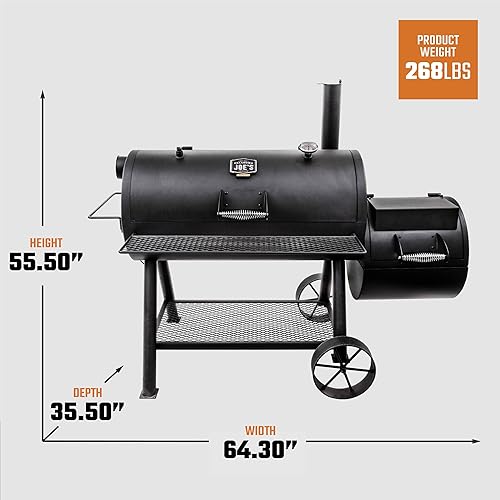
Why It Wins for 2026: It is incredibly versatile. If you want a traditional offset draft, you can configure it accordingly; if you want a set-it-and-forget-it temperature balance across four briskets, you run it in reverse flow.
Pros
- Large cooking capacity;
- Robust steel construction for its price tier;
- Optional reverse-flow baffles included.
Cons
- Large footprint; requires high-temp silicone sealing during assembly for absolute perfection.
3. Best Entry-Level Budget Pick: Oklahoma Joe’s Highland
If you want a true stick burner experience but aren’t ready to spend a fortune, the Oklahoma Joe’s Highland remains the undisputed king of the budget tier.
Unlike cheaper department store options made of stamped tin, the Highland is constructed from high-temperature, heavy-gauge steel. It holds heat significantly better than its competitors, though it does require a bit of active fire management.
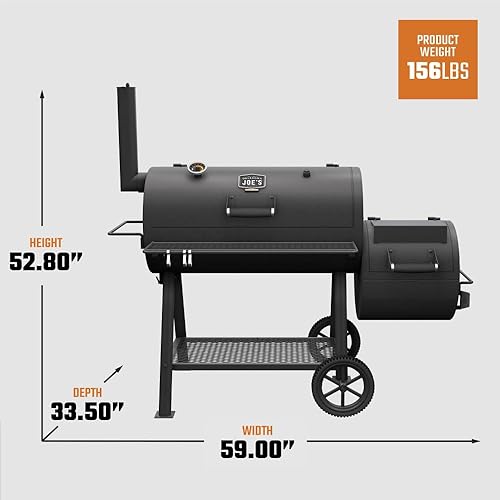
Pitmaster Tip: To turn this into a premium rig, spend an extra $20 on high-temperature gasket tape and toggle clamps to seal the main chamber door. This minimizes smoke leakage and maximizes wood efficiency.
Pros:
- Highly affordable;
- Excellent introduction to fire management.
- Thick construction for the budget class.
Cons:
- Prone to small smoke leaks out of the box if not sealed manually; the smaller cooking chamber limits giant cookouts.
4. Best Heavy-Duty Mid-Tier: Old Country Pits Brazos
If you are ready to step away from mass-market grills and move into commercial-grade territory, the Old Country Pits Brazos is spectacular.
The golden rule of offset smoking is that thick steel retains heat. The Brazos is fully welded out of 1/4-inch structural steel. Once this smoker gets up to temperature, it acts like an insulated oven. Sudden drops in outdoor temperature or a passing windstorm won’t tank your cooking temperature.
Why We Love It: It features a properly designed, lowered smokestack pulling air right across the grate level, which is exactly how custom $5,000 competition pits are built.
Pros:
- True 1/4-inch thick steel;
- Fully welded seams;
- Incredible heat retention;
- Lifetime-level durability.
Cons:
- Extremely heavy (requires multiple people to move); available primarily through specialty distributors.
5. Ultimate Luxury Splurge: Yoder Smokers 20″ Loaded Wichita
The Yoder Loaded Wichita is a competition-grade pit designed for the backyard. Built in Kansas from CNC-machined 1/4-inch steel, its craftsmanship is second to none.
What sets the Loaded Wichita apart is its integrated heat management system. An internal slide plate allows you to tune the airflow perfectly, creating a flawless draft.
Air drafts seamlessly from the large firebox, across the grates, and out the top stack, ensuring clean, blue smoke rather than the bitter, creosote-heavy white smoke produced by poorly ventilated pits.
Investment Value: This is a generational cooker. It features a lifetime warranty against burnout and retains resale value incredibly well.
Pros
- Flawless airflow engineering;
- Counter-weighted door for easy lifting;
- Includes cooking grates in the firebox for direct searing.
Cons
- Premium price tag; requires freight shipping due to its massive weight.
8 Factors to Consider When Buying an Offset Smoker
When reading reviews online, it is easy to get bogged down in dimensions and square inches. When choosing a stick burner today, keep these three primary pillars in mind:
- Steel Thickness (The 1/4-Inch Rule)
Cheap metal (12-gauge or thinner) expands and contracts rapidly when exposed to fire. This causes smoke to leak out of the hinges and doors, making it incredibly difficult to maintain a steady 250°F. If your budget allows, look for heavy-gauge steel. If you can afford 3/16-inch or 1/4-inch thick welded steel, your wood consumption will drop dramatically because the metal itself stores the heat.

- Temperature gauges
Smoking food requires checking the internal temperature constantly. If the smoker has a built-in temperature gauge, there’s no need to open the lid to check if the meat is perfectly smoked. With this, it’s important to look for a brand that gives an accurate reading. There should be 2 thermometers at either end of the offset smoker so that you can determine the temperature difference and make the necessary adjustment.
- Quality seals and dampers
The seals play a big role in controlling the temperature, reducing fuel usage, and improving smoke retention. When you buy an offset smoker, you should check the seals and the dampers for any gaps, but they should be easy to open and close.
- Sturdy design
You should choose a smoker with a sturdy design, particularly the legs and wheels. The latches and hinges should also be strong so that it can handle moving the smoker from one place to another.
- Warranty
An important factor when you plan to buy a smoker is the warranty. No matter how the brand claims to be durable or of good quality, it should carry a warranty. This way, you’ll have peace of mind that you can bring a claim to the manufacturer or dealer in case of potential faults.
- Cooking chamber size
Before you purchase an offset smoker, you should think first about the quantity and frequency of cooking. It’s better to choose a smoker that has enough space and additional hooks and racks to cook a big quantity of food. For additional flexibility, you should choose a smoker with movable racks.
Check if there are counterweights on the chamber lids for additional functionality. Likewise, additional racks, front shelves and bottom shelves can be helpful.
- Firebox size
Regardless of the fuel source that you will use in your smoker, it is best to ensure that the firebox is spacious enough to accommodate the charcoal, split wood, logs or wood chips.
- Easy to clean
Aside from the ease of cooking, it is also important to select a smoker that is easy to clean. There should be a hose through which you can easily drain the barbecue. Likewise, check for features that would spare you from scrubbing the inner part of the smoker.
Traditional vs. Reverse Flow Airflow
Traditional Offsets: Smoke enters from one side of the cooking chamber and exits through a smokestack on the opposite side. This creates a temperature gradient, which is actually useful if you want to cook chicken at higher temperatures closer to the firebox while keeping a brisket low-and-slow on the far side.
Reverse Flow Offsets: An internal baffle plate forces smoke underneath the cooking area first, releasing it at the far end so it sweeps back across the top. This results in uniform temperatures from left to right, making it highly forgiving for beginners.
Advantages of Using an Offset Smoker
Aside from producing the smokiest and richest meats, using an offset smoker offers several advantages, such as the following:
- You can add wood chips, wood pellets, logs, or chunks into the firebox without opening the chamber.
- It can accommodate a large quantity of food, thus cooking at the same time is possible for a large number of people.
- If the smoker comes with customized grill grates, it can be used for grilling, making it more flexible.
- There are no mechanical parts or electrical circuits that may burn out and require replacement.
- It is inexpensive to use, and with proper maintenance, you can expect the offset smoker to last longer.
Disadvantages of Using an Offset Smoker
Just like any other smoker, the offset smoker has a few downsides to expect:
- Starting the fire may take time, as well as heating the smoker
- It is not suitable for after-work cooking because of its slow and low style of cooking
- The weather conditions greatly affect the cooking process
- Maintaining a stable fire can be challenging; that’s why it requires practice and patience
- If you have limited space, an offset smoker is not a good option
- Moving the smoker from one place to another is an issue because most models of smokers are heavy
Safety Concerns of an Offset Smoker
Risks are apparent in almost everything. That’s why it’s important to know those risks in order to prevent them from transpiring. Regardless you may be using you should be prepared for any untoward incidents that may happen.
Obviously, when smoking, fire is a common destructive force. With this, it’s important to have a fire extinguisher within your reach. You also need to know how to control the fire and how to cut the fuel supplies.
Grills or smokers have a particular range of operations. It’s important to read the manual and follow the safety restrictions. If the fuel source of the smoker is charcoal, you need to be extra careful in lighting it, especially if you’re using a lighter. The lighter fluid can cause problems such as burns or worse fire.
Obviously, the downside of using a smoker or a grill is the fact that you will inhale the smoke, which is dangerous to your health. The smoke contains Polycyclic Aromatic Hydrocarbons or PAH, carbon monoxide and other harmful substances. So, when smoking, you should stay at a distance.
Final Verdict
If you are looking for the absolute best balance of modern reverse-flow convenience and heavy steel durability, the Oklahoma Joe’s Longhorn Reverse Flow is our top recommendation for 2026.
If you are a purist who wants a traditional, heavy-duty 1/4-inch steel pit built to last a lifetime, invest your money in the Old Country Pits Brazos or the luxury Yoder Loaded Wichita. Whichever you choose, remember: great BBQ takes patience, good wood, and a clean-burning fire!


Leave a Reply