If you are shopping for an affordable, easy-to-use smoker that features hands-off cooking and delivers delicious flavor, then a gas smoker (also known as a propane smoker) is for you.

There are many advantages to using gas-fueled smokers:
- They are simple to cook on.
- They are affordable.
- Clean, even cooking and heat.
Most consumer units use propane tanks. However, the campsite models are natural gas-friendly.
Though it is possible to modify other brands to use natural gas, the process must only be performed by a professional.
Below are the top-rated gas smokers, evaluated for both their cooking performance and ease of use.
Quick Recommendation Summary
- Best for beginners: Cuisinart 36.”
- Best for large cooks: Masterbuilt ThermoTemp XL
- Best for hands-on BBQ: Pit Boss 3-Series
- Best simple smoker: Camp Chef Smoke Vault
- Best budget option: ATSENT Vertical Smoker
Best Gas Smoker Comparison Table
| Gas Smokers | Cooking Space | Ease of Use | Temp Stability | Customer Rating |
|---|---|---|---|---|
| Cuisinart 36” Vertical | Large | Very Easy | Moderate | Beginners |
| Pit Boss 3-Series PBV3G1 | Very Large | Moderate | Moderate | Hands-on BBQ fans |
| Masterbuilt ThermoTemp XL | Very Large | Easy | Very Good | Regular smokers |
| Camp Chef Smoke Vault 24” | Medium | Easy | Good | Home cooks |
| ATSENT Vertical Smoker | Medium | Very Easy | Fair | Budget buyers |
1. Cuisinart 36” Vertical Propane Smoker
A reliable entry-level smoker that delivers good results without overcomplicating things.
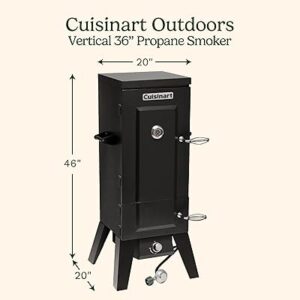
This smoker is popular for a reason. It’s tall, roomy, and simple to use. Setup is straightforward, and once you get the flame dialed in, it holds a steady smoking temperature for most backyard cooks. The smoke flavor is solid, especially for ribs and chicken.
That said, it’s built to hit a price point. Heat retention could be better, and long smoking sessions need occasional refilling of the wood chip tray.
Pros
- Large cooking space for the price
- Easy to use, even for beginners
- Good smoke flavor output
- Widely available replacement parts
Cons
- Thin metal loses heat in cold weather
- The small wood chip tray needs refilling
- The door seal could be tighter
Best for: beginners who want a no-nonsense propane smoker that just works.
2. Pit Boss PBV3G1 3-Series Gas Vertical Smoker
A hands-on smoker for people who enjoy managing their cook.
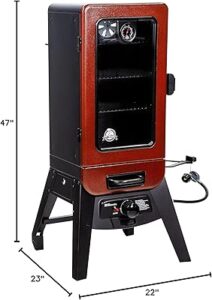
This Pit Boss feels more “BBQ-centric.” It offers generous rack space and gives you real control over heat and smoke. Once you learn how it behaves, it produces excellent results, especially with ribs, sausage, and poultry.
The learning curve is real, though. Smoke leakage is common, and temperature control takes some practice. It’s not a set-and-forget smoker, but some people actually like that.
Pros
- Large cooking capacity
- A dual burner setup offers better control
- A glass door lets you check the food easily
- Strong smoke output
Cons
- Smoke leaks around the door
- Requires practice to stabilize temperature
- Needs frequent cleaning due to the glass door
Best for: backyard cooks who enjoy tweaking and staying involved during the cook.
3. Masterbuilt ThermoTemp XL Propane Smoker
A step up in consistency and capacity.
This smoker shines when it comes to steady temperatures. It’s roomy enough for large briskets or multiple pork shoulders, and heat distribution is more even than most budget models. It’s also easier to clean and manage during longer smoking sessions.
Build quality is mostly good, though not flawless. Some units arrive with minor cosmetic issues, but performance is generally solid.
Pros
- Stable temperature control
- Large interior fits big cuts of meat
- Even heat across racks
- Easy ignition and operation
Cons
- Assembly can be time-consuming
- Paint and finish can be inconsistent
- Slightly higher price than entry models
Best for: regular smokers who want dependable results without moving to pellets or charcoal.
4. Camp Chef Smoke Vault 24” Vertical Gas Smoker
Simple, practical, and consistent.
This smoker doesn’t try to impress with extras. It focuses on doing the basics well. Heat distribution is good, smoke flavor is clean, and the controls are easy to understand. It’s especially good for chicken, fish, and ribs.
The trade-off is insulation. The metal is thinner than that of premium smokers, so windy or cold conditions can affect performance.
Pros
- Even heat distribution
- Simple controls
- Good smoke flavor
- Compact and easy to manage
Cons
- Thinner metal affects heat retention
- Smaller capacity than tall smokers
- Some smoke leakage
Best for: home cooks who want reliable results without a bulky smoker.
5. ATSENT Vertical Propane Smoker
A basic, budget-friendly smoker that covers the essentials.
This is a straightforward propane smoker with no extras. It’s easy to assemble, simple to run, and works well for casual smoking. Temperature control is decent, and airflow is surprisingly good for a budget unit.
You won’t find premium materials or advanced features here, but it does the job if your expectations are realistic.
Pros
- Affordable price
- Easy setup and operation
- Good airflow and rack design
- Compact footprint
Cons
- Basic temperature control
- Limited brand support
- Lighter build quality
Best for: first-time smokers or casual users on a tight budget.
How To Choose The Best Gas Smoker
There are several factors to consider before buying a smoker that feels right for you.
- First off, the price is an essential consideration. There are many entry-level smokers for barbecuing novices that are affordable and work well. The Masterbuilt 2-door propane smoker, for example, is an excellent choice for the beginner pitmaster. They are known for their superb temperature-holding ability. Smokers greatly vary in prices starting from the very cheap at around $50, to the custom-built models that can set you back well over $10,000.
- You should also consider the cuts of meat or items that you plan on smoking. You want to have ample interior space for your needs. If you are planning on preparing food at home for family and friends, then there is no need for high-end gas smokers. Conversely, if you are in the commercial preparation of food, then you need a smoker that can accommodate larger cuts of meat.
- Portability should also be a consideration. Propane smokers are considered more portable than electric ones. Propane smokers can quickly get transported to campsites, picnics, and other outdoor spaces.
- You should also consider the required fuel sources of the smoker before purchasing it. Some smokers rely on natural gas, electricity, wood, charcoal, pellets, and other types. First, ensure the necessary fuel for the smoker is affordable long-term, or even available in your area, before purchasing it.
- Lastly, consider the durability of the smoker. One of the most critical factors is noting the material used to make it. Some smokers are more challenging to clean based on the materials they were manufactured. Removable racks, for example, are far easier to clean than permanent shelves.
Water Smoker vs Dry Heat Smoker
Water smokers use a water pan between the fire and the heating chamber. The purpose of the water is to keep a cooler cooking area that will produce a juicy, tender product compared to dry heat smokers.
The water pan also regulates heat, which maintains temperatures evenly. Dry heat smokers burn with wood products and don’t use water pans.
Some chefs argue that dry heat smokers produce better “bark”, or the smoked skin on the meat; however, there’s no evidence to prove this point.
FAQ Propane Grills
Can you use propane in a natural gas heater?
No, you cannot use propane in a natural gas heater without making some modifications to the heater. Propane and natural gas have different chemical properties and burn at different temperatures, which means that heaters designed for one type of gas may not work properly or safely with the other type of gas.
Natural gas heaters typically use a different type of burner and control valve than propane heaters, and the orifice sizes that control the flow of gas into the burner are also different.
If you try to use propane in a natural gas heater without making any modifications, the burner may not ignite properly or the flame may burn too hot, which can be dangerous.
If you want to convert a natural gas heater to use propane, you will need to replace the burner and control valve with ones that are designed for use with propane, and you may also need to change the orifice sizes.
It’s important to follow the manufacturer’s instructions or consult with a professional to ensure that the conversion is done safely and correctly.
What does liquid propane mean?
Liquid propane refers to propane that has been compressed into a liquid state through a process of cooling and pressurization.
Propane is a flammable gas that is commonly used as fuel for heating, cooking, and powering vehicles. When propane is compressed, its temperature drops, causing it to condense into a liquid that is easier to transport and store.
Does propane burn hotter than natural gas?
Propane burns hotter than natural gas. Propane has a higher energy content per cubic foot than natural gas, which means that it can produce more heat when burned. The heat output of propane is approximately 2,500 to 2,800 degrees Fahrenheit, while the heat output of natural gas is about 1,000 to 1,200 degrees Fahrenheit. This higher heat output makes propane a popular choice for heating and cooking applications where a high level of heat is required, such as in outdoor grills, space heaters, and industrial furnaces.
How to Use a Gas Smoker
- The water pan may be used with cider, beer, or water. You may also line the water pan with foil first to make it easier to clean.
- Open the valve after connecting the propane tank to the smoker. Keep the lid open and light the burner according to the manufacturer’s instructions.
- Now set the regulator to the required temperature.
- Preheat for up to 15 minutes while adjusting the chimney damper or vents as necessary.
- Add wood charcoal, pellets, or chips to the feeder. Keep the lid open until the unit begins to smoke.
- Arrange your food either on the racks or hang it on smoking hooks, if your smoker has them.
- Continue to replenish water and wood as needed and make sure the flame doesn’t go out, which could become hazardous if the gas builds up.
- Once the food finishes cooking, remove it and turn off the burners, and disconnect the gas tank.
In conclusion, there are many different gas smokers on the market. However, a gas/propane smoker is among the most popular for simplicity and convenience.


